Weed infestation can severely reduce crop yields, induce pests and diseases, and increase maintenance costs in agricultural and landscape management. Non-selective herbicides are the most widely used weed control tools, with glyphosate and glufosinate-ammonium being the two most mainstream products globally. Although both can effectively eliminate common weeds, they exhibit significant differences in mechanism of action, efficacy characteristics, and application value.
1.How They Work?
Glyphosate and Glufosinate-ammonium are both broad-spectrum, non-selective herbicides used to control a wide range of unwanted grasses and broadleaf weeds. However, they work in different ways, which gives each product its own advantages in weed control.
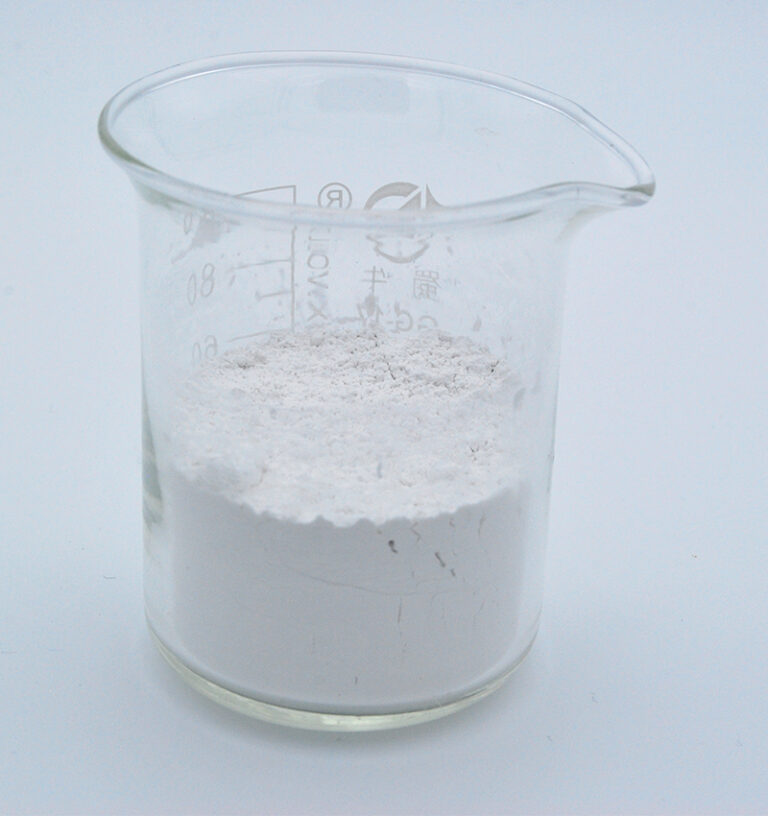
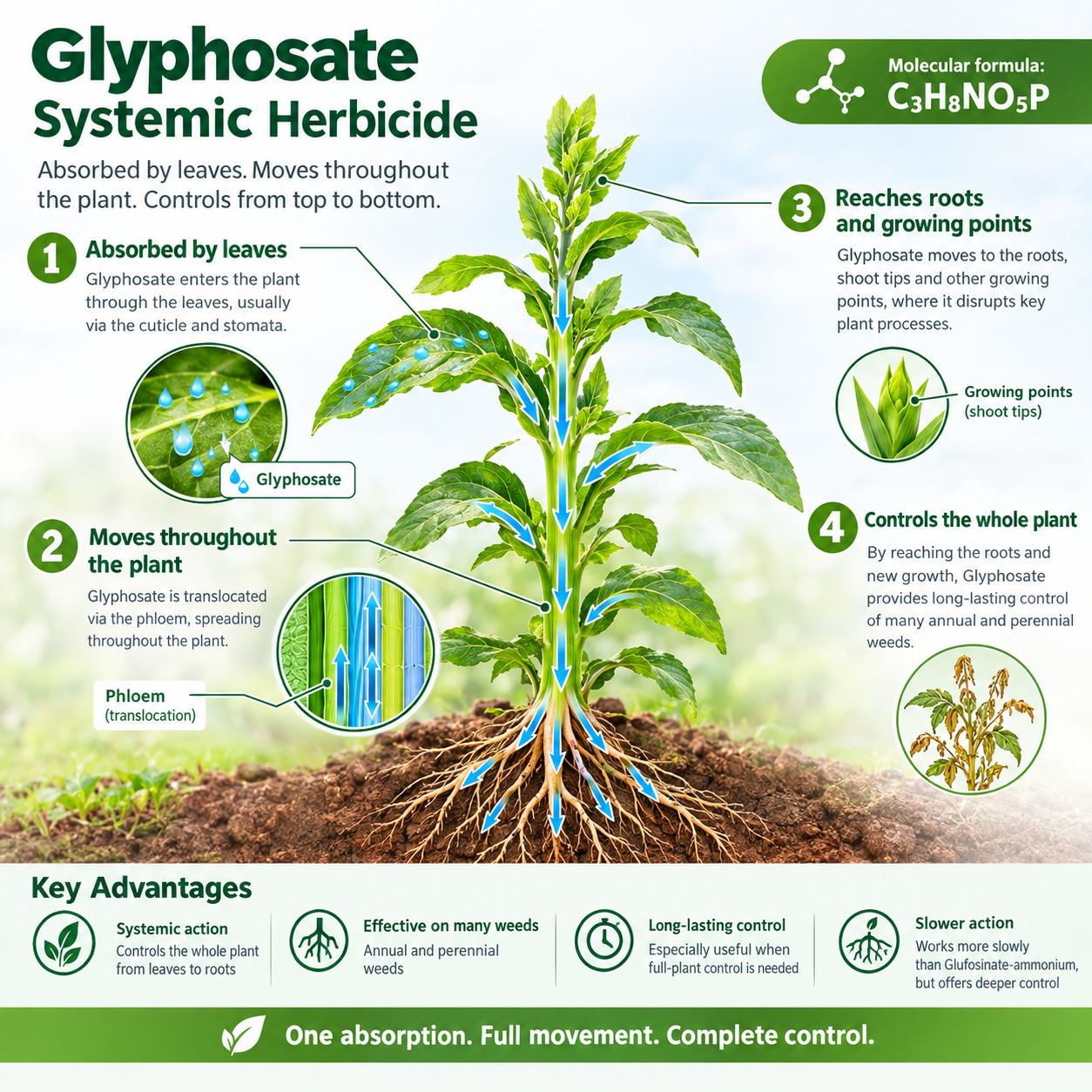
Glyphosate (Molecular formula: C₃H₈NO₅P) is a systemic herbicide. After weeds absorb Glyphosate through their leaves, the herbicide moves throughout the plant and reaches the roots and other growing points. This systemic movement allows Glyphosate to control many annual and perennial weeds, especially when growers need long-lasting control of the entire plant. Glyphosate generally works more slowly than Glufosinate-ammonium, but its ability to move within the plant helps control weeds from the leaves down to the roots.
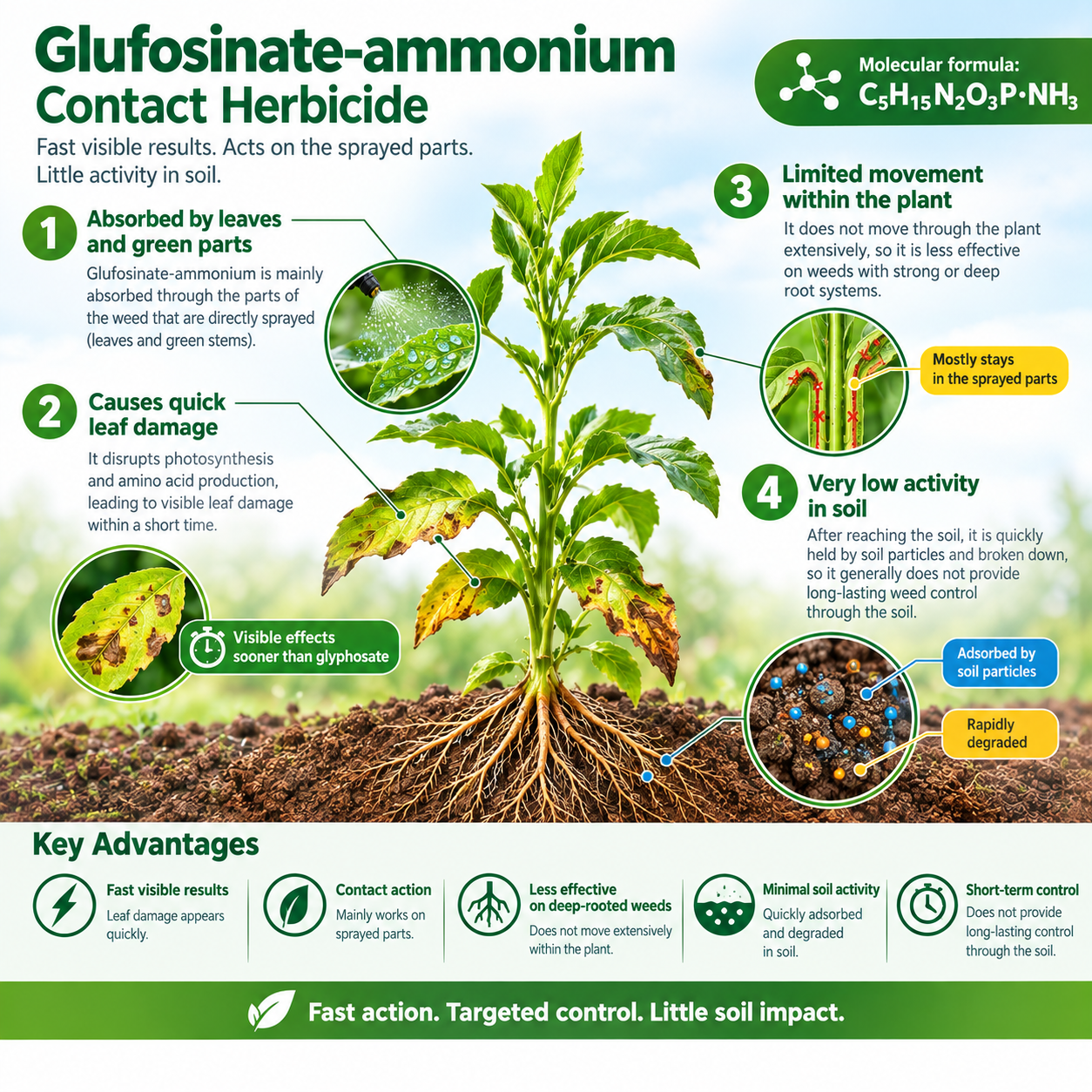
Glufosinate-ammonium (Molecular formula: C₅H₁₅N₂O₃P·NH₃) mainly works through the parts of the weed that are directly sprayed. It causes visible leaf damage relatively quickly, so users can often see the effects sooner than with glyphosate. However, it does not move through the plant as extensively, so it may be less effective on weeds with strong or deep root systems. Another important advantage is that Glufosinate-ammonium has very little activity in the soil. After reaching the soil, it is quickly held by soil particles and broken down, so it generally does not provide long-lasting weed control through the soil.
2.Weed-Killing Speed
Glufosinate-ammonium features extremely fast weeding speed. Under normal temperatures (20–30°C), weeds turn necrotic within 24–48 hours and most annual weeds die completely in 3–5 days, suitable for emergency rapid weeding.
Glyphosate acts slowly due to systemic translocation. Obvious withering appears in 5–7 days, and complete whole-plant and root killing takes 7–14 days, with thorough and long-lasting effects as compensation for its slow speed.
3.Weed Spectrum and Control Efficacy
Both herbicides cover broad weed spectra including common grasses, broad-leaved weeds and sedges. Glyphosate performs best on deep-rooted perennial weeds such as dandelion and thistle, eliminating root buds and effectively inhibiting recurrence.
Glufosinate-ammonium has outstanding control efficacy on glyphosate-resistant weeds like Palmer amaranth. However, it fails to kill perennial weed roots thoroughly, leading to frequent regrowth after foliage withering.
4.Root Control and Recurrence Prevention
Root control is their most essential difference. Glyphosate’s full systemic translocation completely eradicates weed roots, realizing long-term weed suppression with low recurrence rates for field purification.
As a contact agent, glufosinate-ammonium only burns above-ground weed tissues. The intact underground roots remain viable, resulting in high regrowth rates and only short-term weed control effects.
5.Environmental Adaptability and Safety
Glufosinate-ammonium is suitable for high temperature and high humidity, and its efficacy is stable. It leaves almost no soil residue because it is rapidly decomposed by soil microorganisms, has no phytotoxicity to subsequent crops, and has high planting safety.
Long term continuous use of glyphosate can lead to the accumulation of soil residues, which may inhibit the growth of sensitive crops and affect soil microbial activity. In addition, under low temperature and rainy conditions, its therapeutic effect significantly decreases.
6.Pros and Cons of Two Herbicides
Glyphosate: Stable and Thorough with Hidden Risks
Advantages: Thorough whole-plant and root killing, long-lasting weeding effect, low cost and wide adaptability for large-scale promotion.
Disadvantages: Slow action speed unable to meet emergency weeding needs; long-term single use induces severe weed resistance and soil ecological problems.
Glufosinate-ammonium: Efficient and Safe with Limitations
Advantages: Fast weeding effect, no cross-resistance with glyphosate to solve resistant weed problems, low soil residue, high crop safety and stable efficacy in high temperature.
Disadvantages: Higher application cost, poor control on perennial deep-rooted weeds, high regrowth rate, and requires uniform spraying for ideal effects.
7.Scenario based drug selection guide
The following scenarios recommend using glyphosate
Glyphosate is suitable for weeding large areas of wasteland, farmland with perennial weed growth, and cost sensitive scenarios that require long-term and thorough weed suppression. It plays an irreplaceable role in preventing and controlling deep-rooted perennial weeds.
The following scenarios recommend the use of glyphosate ammonium
For fields with glyphosate resistant weeds, orchards and nurseries with extremely high safety requirements, emergency situations that require rapid weed control, and rotating medication plans implemented to delay resistance, glyphosate ammonium is the preferred agent.