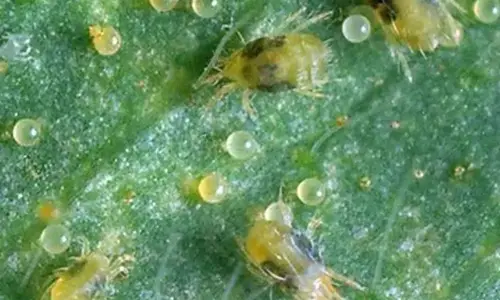
Corn field pests and their symptoms
Corn crops suffer from a wide range of destructive pests throughout the whole growing cycle, including cutworms, corn borers, armyworms, corn aphids, spider mites, corn cyst nematodes and root-knot nematodes. If left uncontrolled, these pests trigger varying degrees of yield loss year after year, while severely downgrading grain quality, resulting in huge economic losses for maize growers globally.
Here we split common pests based on the corn parts they damage. Each entry includes clear pest damage symptoms and field images to help you diagnose problems fast and pick the right pest control solution.
Corn field pests-Root and stem base pests
Common pests attacking maize roots and stem bases fall into two categories: soil insects and nematodes.
Soil insects include cutworms, wireworms, white grubs and mole crickets. They gnaw through seedling stem bases and feed on seeds and root systems, killing young seedlings and causing uneven, sparse crop stands.
Nematodes mainly consist of corn cyst nematodes and root-knot nematodes. These parasites live inside plant roots, triggering root galling and root rot. Affected maize plants turn stunted and yellow, grow slowly, and may even produce barren stalks with no ears.
Foliar and Whorl Pests
Common pests affecting corn foliage and central whorls fall into two distinct categories, namely grazing pests and sap-sucking pests.
To start with, grazing pests cover multiple insect orders. Specifically, they consist of lepidopteran insects such as corn borers, armyworms, fall armyworms, cotton bollworms, and beet armyworms; followed by coleopteran insects including scarab beetles and leaf beetles; as well as orthopteran insects represented by grasshoppers. Once infestation occurs, these pests will first bore into the central whorls and then voraciously consume leaf tissue. As a result, jagged leaf notches will form, and in severe cases, the entire foliage may get completely devoured.
On the other hand, sap-sucking pests mainly comprise aphids, thrips, planthoppers, and spider mites. Unlike grazing pests, they pierce leaf surfaces to suck cell sap continuously. Consequently, infested leaves gradually turn yellow and develop dried leaf tips. What’s more, thrips and planthoppers act as critical virus vectors, which means they can further spread harmful plant viral diseases across corn fields.
Insect pests inside the stem
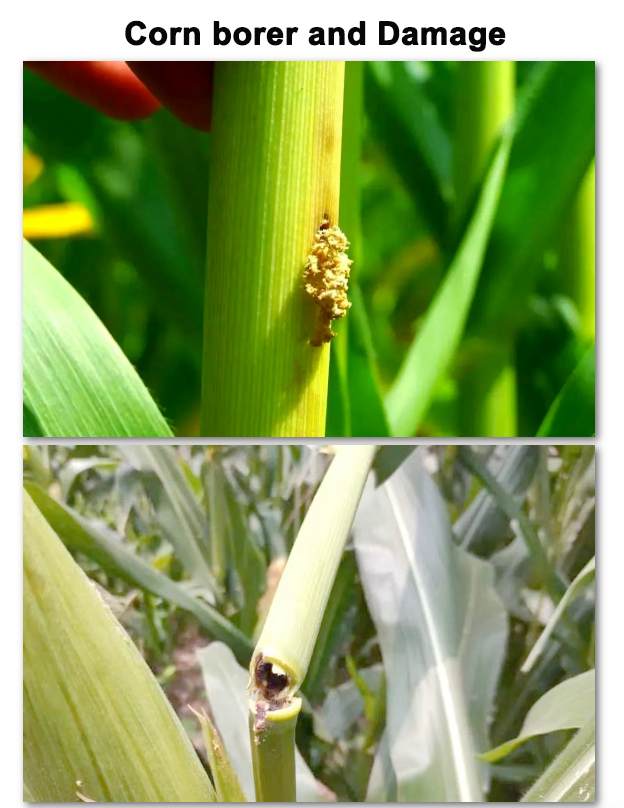
Common pests affecting corn stalks are primarily borers, such as the corn borer and some older larvae of the cotton bollworm. To begin with, they bore into the stalks and create hollow tunnels inside. This action severely damages the stalk’s vascular tissue, and as a result, corn stalks are easy to break under wind pressure. Furthermore, the wounds left by boring open the door to fungal infection and stalk rotting. In the most serious scenarios, vast numbers of plants will form empty stalks with no corn ears. Ultimately, these pests bring immense yield damage to corn fields.
Ear pests (male ear, female ear, silks and grains)
Corn field pests that target reproductive parts are diverse. Common pests affecting corn ears, a key group of Corn field pests, can be categorized into three types: borers, suckers, and gnawers. Borers include corn borers and bollworms, which burrow into the ears and feed on the silks and kernels, leading to abnormal pollination and mold growth on the silks, kernels, and ears. Suckers include aphids, which often congregate on fresh silks, husks, and newly emerging tassels to suck sap, causing abnormal pollination and rotten kernels. Gnawing pests include various scarab beetles and leaf beetles, which often gnaw on the silks, husks, and tender kernels on fresh ears, leading to abnormal pollination and mold growth on the silks, kernels, and ear tips.