Atrazine 26% + Mesotrione 6% + Nicosulfuron 4% OD
What Is Atrazine 26%+Mesotrione 6%+Nicosulfuron 4% OD?
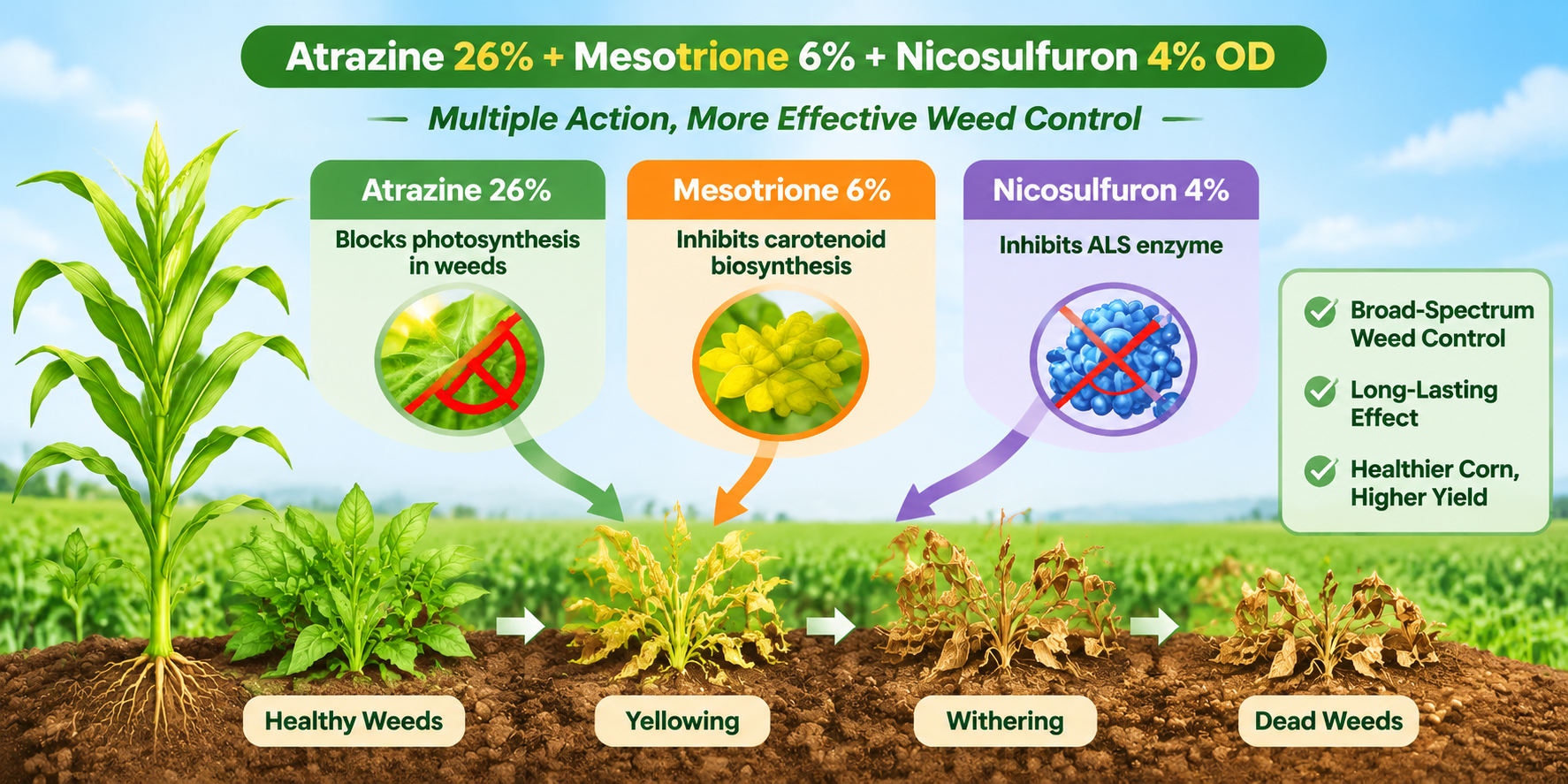
Nicosulfuron targets grass weeds by disrupting internal growth signalling. Mesotrione blocks pigment production in broadleaf weeds, stopping them from harvesting sunlight. Atrazine delivers immediate contact activity on emerged broadleaf weeds plus residual soil activity to suppress successive weed germination.
This factory pre-mixed OD post-emergence herbicide is designed for field corn weed management. Unlike water-based SC formulations, its oil-based system carries fine active particles and acts as a built-in adjuvant, helping the spray spread, stick and penetrate waxy weed leaf surfaces. The precisely blended ratio of three active ingredients provides broader weed control than single-component herbicides, combining the knockdown of existing weeds with residual soil activity to help suppress new weed growth.
What Weeds Does This Blend Actually Control?
This three-way herbicide provides broad weed control in corn fields, covering both grass and broadleaf weeds. It helps control barnyard grass, crabgrass, foxtail, wild millet, pigweed, lambsquarters, cocklebur, velvetleaf, purslane, redroot amaranth and common knotweed.
For best results, apply when weeds are at the 2–4 leaf stage, when they are still young and easier to control. Larger, mature weeds with well-developed root systems may be more difficult to control. Deep-rooted perennial grasses and volunteer corn are not controlled by this product and require separate weed management.
Why Buy This 3-in-1 Mix Instead of Three Separate Products?
Unlike single herbicides, this triple-action formula targets both grass and broadleaf weeds in one application, helping reduce reliance on a single mode of action and supporting better resistance management when used as part of an integrated weed control program.
Its factory-pre-mixed formula eliminates the need for on-farm mixing, avoiding incorrect ratios and compatibility issues while reducing spraying passes, labour, fuel costs and field traffic. The oil-based OD formulation also helps the spray spread and adhere to weed leaves, improving coverage without the need for a separate oil adjuvant, where permitted by the product label.
On Which Crops Can I Apply It, and When Is the Best Window?
This product is intended for use on conventional field corn and forage corn.
It is not suitable for sweet corn, waxy corn, popcorn or corn breeding lines. These varieties have low tolerance to nicosulfuron and face high risk of serious crop injury.
The optimal application window is corn at the 3–5 leaf stage, paired with weeds at 2–4 leaves. At this stage, corn has built sufficient tolerance, while weeds are small and most receptive to herbicide uptake. Avoid application once corn passes the 6-leaf stage, or during hot midday hours when crop stress risk rises sharply.
What Dosage and Spray Method Give the Best Result?
Always follow the local label rate matched to your soil type and weed pressure. Add the product to clean water and keep the tank agitated during spraying to maintain uniform dispersion. Full, even leaf coverage is critical; partial coverage leads to surviving weeds and inconsistent results.
Spray only when wind speed is low to minimise drift. Drift droplets can severely damage nearby sensitive crops including soybean, sugar beet and all types of vegetable crops. Do not apply if heavy rain is forecast within the next several hours.
Thanks to the OD oil carrier, spray droplets cling better to leaf wax layers and resist wash-off compared to standard water-based formulations.
How Does It Kill Weeds, and How Long Until I See Results?
Weeds absorb the agent through their leaf tissue, after which the active ingredient is translocated downward within the plant to the growing points and roots.
Symptoms can be observed within 2 to 5 days: broadleaf weeds exhibit fading and chlorosis, while the emergence of new leaves on grass weeds ceases. Sensitive weeds typically wither and die completely within 7 to 14 days.
Because the active ingredient is translocated down to the root zone, the likelihood of weed regrowth is extremely low—a significant contrast to contact-type herbicides, which only scorch the above-ground foliage. The oily carrier in the formulation facilitates faster and more reliable absorption, proving particularly effective on weed leaves that are otherwise difficult to wet.
Is It Safe for Corn, and What Causes Injury?
When applied at the appropriate dosage, during the recommended growth stage, and under favorable weather conditions, field corn remains safe and continues to grow normally.
The risk of crop injury increases significantly under the following circumstances: excessive application dosage, application outside the 3- to 5-leaf stage, spraying during low-temperature conditions, or tank-mixing with organophosphate insecticides. In some cases, corn leaves may exhibit temporary, mild yellowing; however, the crop typically recovers on its own, with no impact on final yield.
How Long Does Protection Last After One Spray?
Beyond killing emerged weeds, atrazine stays active in the top soil layer to inhibit weed seeds from sprouting.
The length of residual control varies based on soil organic matter, soil moisture and rainfall. Under typical field conditions, one application provides multiple weeks of extended suppression against late-germinating weeds, reducing the need for follow-up sprays in many fields.
Packaging, OD Formulation and Private-Label Options for Buyers
This oil dispersion (OD) formulation is free of dust, easy to pour and disperses smoothly when mixed into spray water. Unlike water-based SC, the oil carrier protects sensitive actives from hydrolysis, delivers built-in spreading and penetration, and reduces the need for extra tank adjuvants. It mixes reliably and stays stable during storage with minimal settling.
Available standard pack sizes: 1L, 5L, 20L.
We support OEM private branding for qualified distributors. Our sales team can share MOQ, custom labelling and packaging specifications upon request.
FAQ
Q1: Can I spray it before my corn comes out of the ground?
A: This product is designed for post-emergent use after corn and weeds have emerged. It is not intended as a standalone pre-emergence treatment.
Q2: How long after spraying can it rain without washing it away?
A: Allow 4–6 hours of dry time for full absorption. Thanks to the OD oil carrier, it holds up better to light rain than water-based formulations, but heavy rainfall before this window will still reduce uptake and weaken final control performance.
Q3: Can I mix this product with insect sprays?
A: Tank mixing is not universally safe. Do not combine it with organophosphate insecticides, as this combination greatly increases corn injury risk. If you plan any tank mix, run a small compatibility test on a crop area first.
Q4: Will leftover chemical in soil hurt crops I plant next season? What break do I need?
A: Residual activity remains in soil after application. If your rotation includes soybean, beet or vegetable crops, you must respect the required plant-back interval to avoid carryover damage to rotational crops.
Q5: Can I spray sweet corn, waxy corn or popcorn?
A: No. These corn varieties have low tolerance. Application will likely cause severe stunting, leaf burn and permanent crop loss.
Q6: What if my weeds are already big with 4–5 leaves or more?
A: Control efficiency drops on mature weeds with established root systems. Late application often leaves surviving weeds, and a follow-up treatment may be required. We always prioritise early-stage spraying.
Q7: Some weeds turned white but still stay green and alive. Why?
A: This symptom points to partial resistance within that weed population, or insufficient spray coverage on the growing point. Such weeds will not be fully controlled.
Q8: How much water do I need and which spray nozzle works best?
A: Use enough carrier water to achieve full canopy coverage. Flat-fan nozzles are recommended. Avoid fine droplet settings that increase off-target drift risk.