
| Fludioxonil | |
| Processable Formulations | 250g/L SC |
| Packing | Liquid:50ml、100ml、250ml、500ml、1L、5L、10L、20L…… Solid:10g、50g、100g、250g、500g、1kg、5kg、10kg、25kg…… |
| Label | Customized |
| Applicable Scenarios |
|
| Target disease | Gray Mold, Botrytis Fruit Rot, Damping-Off, Stem Rot, Fruit Rot. |
| Certification | SGS、 ISO 、BV |
| Delivery time | 20-30 days |
| Packaging and Labeling |
Customization Available
|
| Payment terms |  |
Fludioxonil 250 g/L SC is a broad-spectrum fungicide designed to help control various fungal diseases, including gray mold, fruit rot, and other crop infections. It helps stop harmful fungi from growing and spreading, protecting crop quality and reducing disease-related losses. With its convenient suspension formulation, it is suitable for professional crop protection programs. Customized packaging and OEM/ODM services are available to meet different market needs.
Fludioxonil 250g/L SC
Fludioxonil 250g/L SC is a suspension concentrate widely used by growers to proactively protect crops. Many follow the habit of waiting until visible symptoms like leaf spots or rot appear before taking action. However, effective field management hinges on implementing protection before damage takes root. Prolonged dew or continuous rainy weather creates persistent conditions for disease outbreaks. Reactive treatment after symptoms emerge often leads to recurring issues. In orchards, vegetable fields, vineyards, potato fields, and grain-growing regions, an increasing number of growers are incorporating this product into their year-round protective plans.
What kind of environment is most likely to quietly harm crops?
Many people simply assume that rain will inevitably damage crops and rot seedlings. In reality, it is not the rain itself that causes harm. When leaves or fruit surfaces remain wet with water droplets for extended periods, pathogens have the opportunity to attach and gradually invade the plants. During this process, the surface may appear intact, but by the time visible decay is observed, the damage has already taken effect.
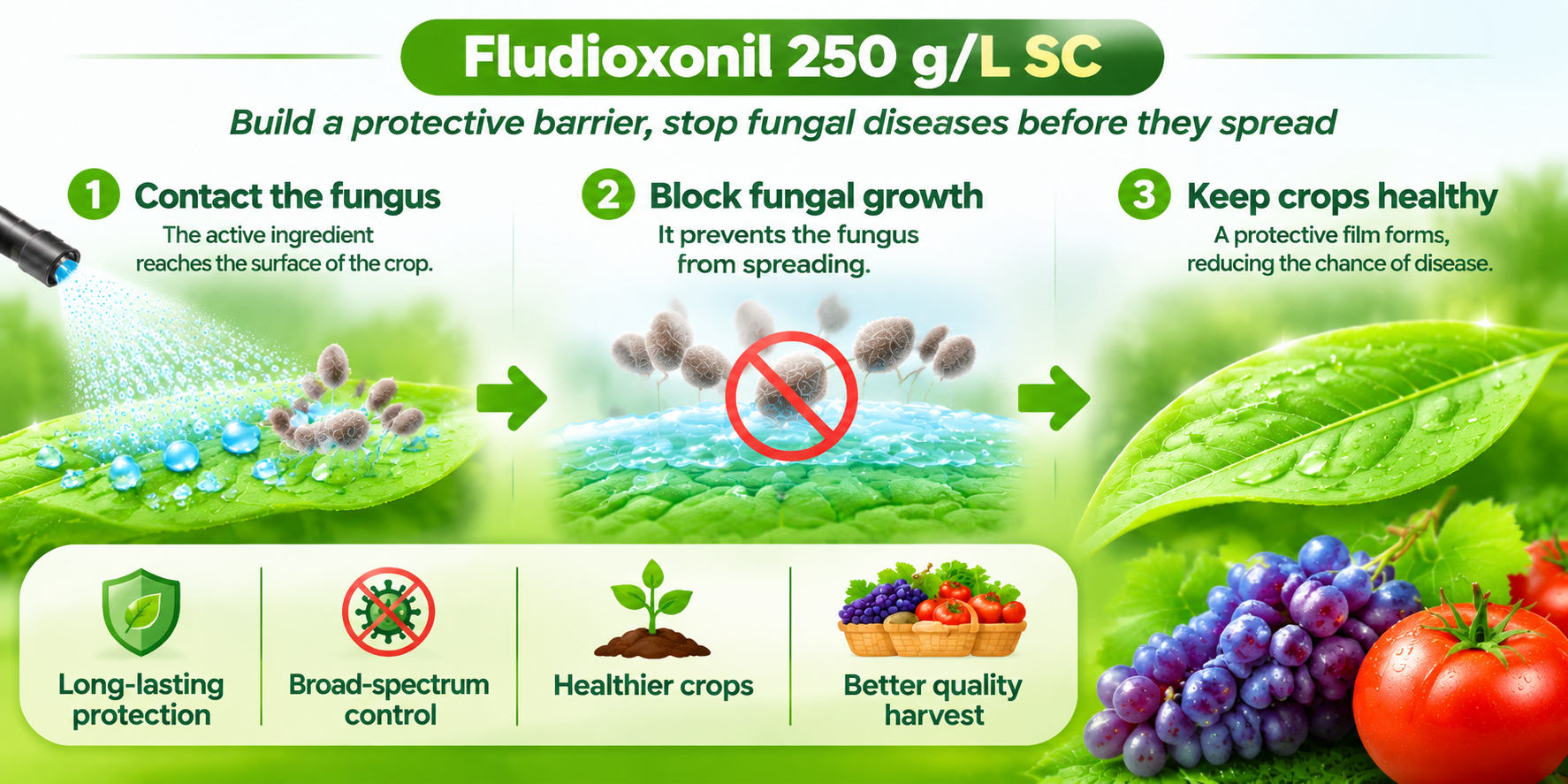
Focus on protecting fruit clusters, tuber skins, newly emerged seedlings, and freshly harvested fruits. Field spraying protects crops during growth, but growers also need proper post-harvest protection to prevent diseases from developing during storage and transportation. Dew and rain can wash away ordinary protective products, making long-lasting protection difficult. Fludioxonil 250 g/L SC helps form a protective layer on crop surfaces, reducing the chance of fungal infection. It helps prevent disease before it develops rather than treating damage after it occurs.
What crops can Fludioxonil be used on?
It is suitable for grapes, berries, fruit trees, vegetables, potatoes, grain crops, and nursery seedlings. Pay special attention to vulnerable growth stages, such as fruit development, rapid vegetable growth, and early seedling emergence, when crops need extra protection.
Paired with different usage methods, it can be sprayed on stems, leaves, and fruits, used to treat seeds, or used to protect fruits after harvesting. It connects the underground, seedling stage, and storage stages, filling in many protective gaps missed in planting plans.
What determines the protection time after proper application?
There is no fixed number for the duration of protection, and it mainly depends on whether the medicinal solution can remain stable on the surface of the crop and the subsequent weather changes. If the adhesion of the medicine is poor, several dewdrops or a light rain will wash it away, and the protection will fail prematurely.
Fludioxonil 250g/L SC has good adhesion ability, and usually after rainwater, there is still enough protective layer left on the surface. For farmers who plant on a large scale, this is crucial: they can arrange the spraying time reasonably, avoid frequent planting in humid weather, and save labor and fuel. Experienced growers usually spray in advance before the arrival of humid weather to establish a defense line.
What differences will suspended dosage form bring to field use?
Our suspension formulation uses finely ground active ingredients to ensure even dispersion and consistent spraying. Some competing products may separate during long-term storage, causing uneven application, insufficient disease control in some areas, and excessive crop exposure in others.
Fludioxonil 250g/L SC formula is stable, and even liquid medicine can be prepared after simple mixing. Conventional spray equipment can be used normally, and it is not easy to block the nozzle. Uniform spraying is the foundation of stable effectiveness. If the medicine itself is difficult to mix evenly, even with good management and protection ideas, the overall effect of the field will be uneven.
What principles should be followed when spraying with other field care products?
Many growers hope to handle multiple tasks in one go, saving valuable farming time. Fludioxonil 250g/L SC can be used in conjunction with commonly used field care products, but this does not mean that mixing it randomly is not a problem. Mixing some products together can weaken the adhesion ability of the medication and shorten the protection time.
Always test a small mixture first, then spray a small area and monitor the crops for several days. Once you confirm no damage or abnormal reactions, proceed with large-scale application. Skipping this step can lead to disappointing results.
How to use it for the best effect in places with frequent rain and heavy fog?
The most difficult thing to deal with in humid areas is not a heavy rain, but the long-term humid air that is always suitable for the development of diseases. Relying solely on pesticides cannot completely eliminate the problem, it is just one part of the entire field management system.
Fludioxonil 250g/L SC can provide stable protection in such environments, but the best time is to spray it in advance before continuous humid weather arrives. Spray before disease symptoms appear, as treatment cannot easily reverse existing damage. Improve ventilation and thin the fruit to reduce humidity inside the canopy and enhance protection.
What are some common pitfalls when using Fludioxonil 250g/L SC?
Many people think that using more will result in longer protection time. In fact, increasing the dosage to a certain extent will not significantly improve the protective effect, but will only increase the cost and bring unnecessary burden to crops.
Control spraying time, ensure thorough coverage, and protect crops during their most vulnerable growth stages. Spray when the wind is calm and leaves are dry, avoiding midday heat and approaching rain. Store the product in a cool, ventilated place away from children and livestock. Wear protective equipment during application and dispose of leftover spray solution properly. Follow a regular crop protection schedule instead of increasing the dosage to deal with unexpected risks.
FAQ
Q1:Can this product be used for seed processing?
It helps protect seeds and young seedlings from fungal damage during early growth, supporting healthier emergence. Application methods vary by crop, so proper use should be confirmed before large-scale treatment.
Q2:Is it suitable for grapes, potatoes, and food crops?
We have experience with grapes, potatoes, and various food crops. Each crop has different protection needs, so application methods should be adjusted to suit its growth stage and vulnerable parts.
Q3:After spraying, if it rains, should we spray again?
It adheres well, and light rain usually won’t wash it away. Reapplication depends on rainfall duration, crop growth stage, and upcoming weather. Rain alone doesn’t mean another spray is needed.
Q4:Why is it recommended to try it out on a small scale for the first time?
This is a common practice to avoid risks. Especially when mixing with other products or using it for the first time on such crops, trial spraying is not only to see if it will harm the crops, but also to observe the adhesion of the spray after spraying, avoiding discovering that it is not suitable after spraying the entire field.


